When we speak about whisky, the flavour doesn’t come only from grains or ageing in oak barrels, the still used during distillation plays a major role in shaping the spirit. Two of the most important distillation methods in whisky production are the Pot Still and the Patent Still. While both serve the same purpose, they create very different styles of whisky. Let’s decode Pot still vs Patent still.
Understanding the difference between these two stills helps us appreciate why some whiskies are rich, bold, and full-bodied, while others are lighter and smoother.
What Is A Pot Still?– Pot Still Vs Patent Still
A Pot Still is the traditional distillation method and one of the oldest methods used in whisky making. It is usually made of copper and works in batches, meaning each distillation is done separately in batches.
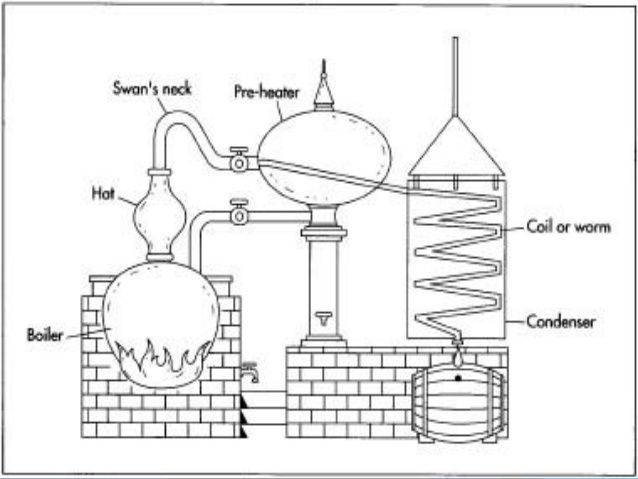
https://en.wikipedia.org/wiki/EsterIn this process, the wort is heated inside the still. Now, the temperature of the boiler is maintained around 78 – 80 degrees Celsius. Because Alcohol evoprates at 78.3 degrees Celsius. Alcohol vapours rise, travel through the swan’s neck, go through a pre-heater and condense back into liquid form through the coil. Most pot still whiskies are distilled twice or sometimes three times, which helps refine the spirit while still retaining its character. As shown in the picture, all retained vapours are condensed back without separating any other congeners or esters (in simple terms when a chemical reaction where acid reacts with alcohol. These esters are responsible for the spirit to have many floral and fruity notes).
Characteristics of Pot Still Whisky
- Rich, bold, and complex flavours
- Heavier mouthfeel
- Strong grain and ester notes
- Often associated with artisanal and traditional styles
Pot stills are commonly used to produce single malt whiskies, especially those known for depth, texture, and individuality.
Pro note: Pot stills are not restricted to distilling whisky. They can also be used to distil other spirits. For example, Ketel One is a pot-distilled vodka.
What Is a Patent Still?– Pot Still Vs Patent Still
A Patent Still, also known as a Continuous still, Column Still or Coffey Still, was invented by Aeneas Coffey in the 19th century. Unlike pot stills, patent stills operate on a continuous distillation process, allowing spirit to be produced efficiently and in larger quantities. The main purpose of the Patent still is to continuously distil wash, allowing for more efficient and consistent production of spirits.
Once the distillation has started, the tall columns have a different outlet, each to collect the different components. Each component evaporates at a particular temperature, like Esters and Congeners, these is very volatile, just like alcohol at 78 degrees.
This system uses tall columns instead of a single pot, where alcohol is continuously separated at 78 degrees Celsius and refined. The result is a much purer and higher-strength spirit.
Patent stills are widely used for making grain whisky, which often forms the backbone of blended whiskies.
Key Differences Between Pot Still vs Patent Still
| Feature | Pot Still | Patent Still |
| Distillation Style | Batch distillation | Continuous distillation |
| Flavour Profile | Rich, complex, full-bodied | Light, smooth, clean |
| Alcohol Strength | Lower | Higher |
| Production | Small, traditional | Large, efficient |
| Type of whisky | Single malt, like Irish and Scotch whiskey | Grain whisky & blended whiskey |
Are Pot Still And Patent Still The Same?
Neither is better than the other; they simply serve different purposes, depending on the style of whiskey. Pot stills, having a single outlet at distillation preserves flavour and individuality, while patent stills offer efficiency and smoothness. In fact, many of the world’s most popular whiskies use both styles together, especially in blended whiskies, balancing character with being very palate-friendly.
Understanding these distillation methods allows whisky lovers to make more informed choices and deepens the appreciation of what’s inside the glass.
Disclaimer: Images and external links used in this article are for informational and illustrative purposes only. Credits belong to their respective owners unless otherwise stated
No responses yet